

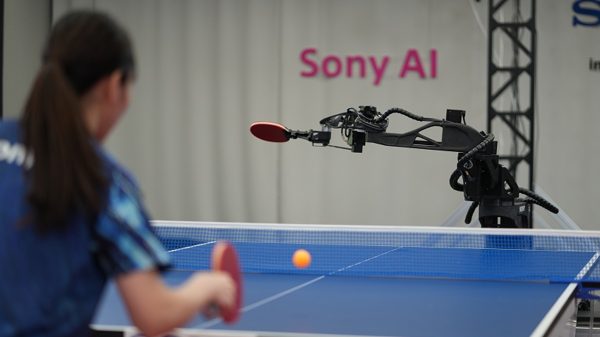










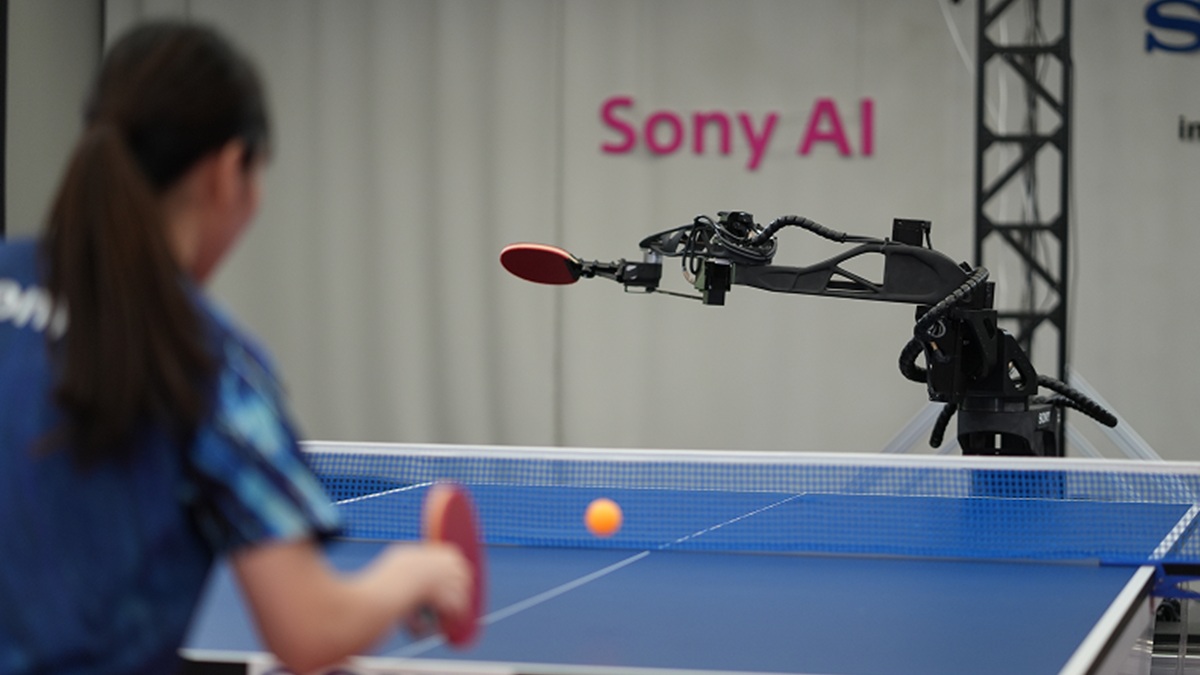
Sony AI has revealed project Ace, the ‘first known’ real-world autonomous system competitive with elite and professional-level human table tennis players. Featuring on the cover of Nature, Sony claims that, “This marks the first time a robot has achieved human, expert-level play in a commonly played competitive sport in the physical world – a longstanding milestone for AI and robotics research.”
For decades, AI systems have demonstrated ‘superhuman’ performance in digital domains – from chess to Go to complex video games. However, applying AI to the physical world, especially in the high-speed domain where perception, planning and control unfold in milliseconds, has remained one of the field’s most significant challenges.
Ace combined Sony’s sensor technology, reinforcement learning and precision hardware to achieve expert-level play in a sport that demands fast, precise and adversarial interactions near obstacles and at the edge of human reaction time. Building on Sony AI’s breakthrough research on its superhuman AI agent Gran Turismo Sophy in the high-speed virtual domain, Ace extends this progress into real-world environments, exploring how robots can perceive, plan, and act with high-performance human speed and accuracy in dynamic environments.
The research implications extend beyond sport. By solving a problem that requires exceptional real-time sensing and control, this research lays the groundwork for AI systems that can safely and reliably operate in dynamic physical environments, ranging from safety-critical settings to real-time interactive domains, where outcomes can benefit from interactions at the edge of human performance.
“This research has shown that an autonomous robot can, in fact, win at a competitive sport, matching or exceeding the reaction time and decision making of humans in a physical space,” said Peter Dürr, Director of Sony AI in Zürich, and project lead for Ace. “Table tennis is a game of enormous complexity that requires split-second decisions as well as speed and power. This research breakthrough highlights the potential of physical AI agents to perform real-time interactive tasks, and represents a significant step toward creating robots with broader applications in fast, precise, and real-time human interactions.”
At the edge of human reaction time
For the results reported in the Nature publication, Ace was evaluated in matches against five elite players and two professional table tennis players, under International Table Tennis Federation (ITTF) regulations. Ace achieved three victories in five matches against the elite players, along with competitive performances in the remaining matches.
Following submission of the Nature manuscript, the team conducted additional competitive matches in December 2025 and March 2026. In the December matches against four new players – two professional and two elite – Ace defeated both elite players and one professional player, while losing to the second professional opponent. In the March 2026 matches against three new professional players Ace defeated all three players at least once. Compared with earlier evaluations, Ace demonstrated higher shot speeds, more aggressive placement closer to the table edge, and faster-paced rallies, reflecting continued performance gains under competitive conditions.
“This breakthrough is much bigger than table tennis,” said Peter Stone, Chief Scientist at Sony AI. “It represents a landmark moment in AI research, showing, for the first time, that an AI system can perceive, reason and act effectively in complex, rapidly changing real-world environments that demand precision and speed. Once AI can operate at an expert human level under these conditions, it opens the door to an entirely new class of real-world applications that were previously out of reach.”
You can read more about the project here.

Steve is an award-winning editor and copywriter with more than 20 years’ experience specialising in consumer technology and video games. With a career spanning from the first PlayStation to the latest in VR, he's proud to be a lifelong gamer.