


















The organisers of GDC Festival of Gaming have released the results of the 2026 State of the Game Industry Survey, offering insights into key game industry trends based on responses from more than 2,300 game industry professionals. The survey was developed in collaboration with research partners at Omdia and the Game Developer editorial team, while internal AI tools were used during the research phase.
Survey results indicate that over one-third (36%) of game industry professionals are using generative AI tools as part of their job. 30% of respondents at game studios reported using AI tools, which is far less than the 58% of those at publishing companies, support teams, and marketing/PR firms that reported to use AI tools. Business professionals’ use (58%) far outweighs that of most other disciplines.
Men (41%) reported using AI more than women (35%), older workers (46%) more than younger ones (34%), and those with a Master’s or PhD (45%) said they turn to it more than those with a Bachelor’s degree or lower (33%).
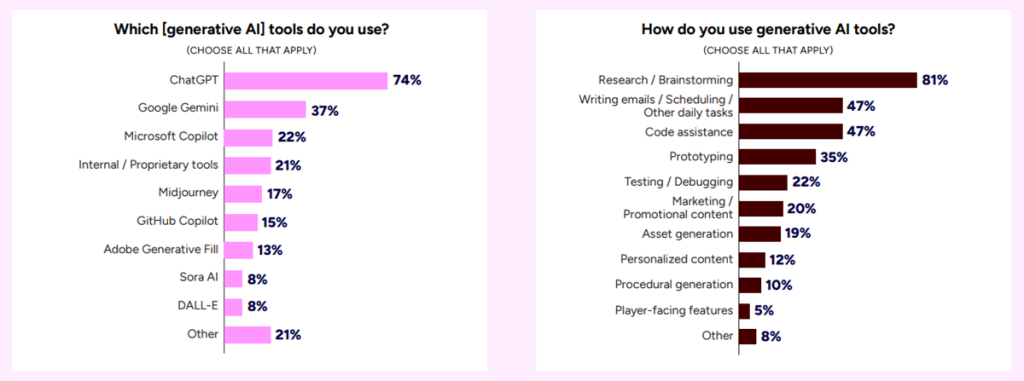
Sentiment from games industry professionals that participated reveals that they often balance the use of multiple AI tools for different purposes, rather than relying on a single platform or use. The most used AI tool for game industry professionals are large language models (LLMs)—mainly ChatGPT (74%), followed by Google Gemini (37%) and Microsoft Copilot (22%). The most common use is research or brainstorming (81%), followed by daily tasks (like writing emails) and code assistance (47% each), and prototyping (35%).
Opinions on Generative AI Hit a New Low
The survey finds that, “It appears that the more game industry professionals
know about generative AI, the less they like it.”
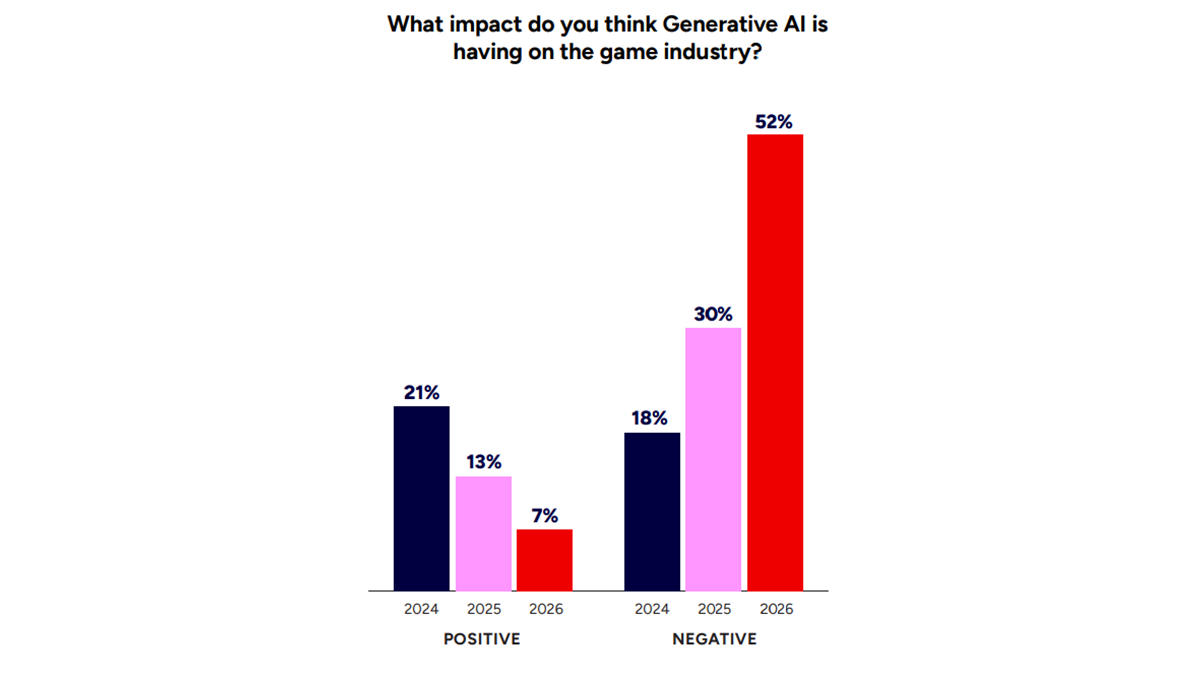
According to this year’s survey, over half (52%) of game industry professionals think generative AI is having a negative impact on the game industry, up from 30% last year and 18% the year prior. Workers in visual and technical art (64%), game design and narrative (63%), and game programming (59%) hold the most unfavorable views.
About 7% of respondents think generative AI is having a positive impact on the game industry, down from 13% in GDC’s 2025 report. That amount is higher for executives, and those in business operations and services (19% each).
From positive to negative
The survey includes direct quotes from respondents divided into responses by Positive, Mixed and Negative Impact. Here’s a small selection:
“We are a small team, so it is making us capable of achieving more than we would without it.” Executive Vp (Independent Studio <5 Years), California
“Anything that needs to scale but would not be possible for a one-man-show with a few freelancers is up for grabs for AI. It is worse to NOT make the game.” Solo Developer (Game Production), Germany
“AI is theft. I have to use it, otherwise I’m gonna get fired.” Senior Employee (Visual And Technical Arts), Ukraine
“I’ve already lost a job and known countless others who have lost their jobs to AI, and so I think it’s foolish to not prepare for the inevitable future and try to learn and understand as much as possible about the tooling and its potential usage. Because company heads and leaders will always be looking for where they think they can save a buck or two.” Director (Business And Strategy), Washington State
“Gen AI on the whole is wretched. It’s built on theft and plagiarism, it uses insane amounts of energy. It’s convinced so many gullible rich idiots that it’s a magic wand, but it’s just a bullshit generator. All it can do is spew out predictive garbage that vaguely resembles things it’s been trained on. Fuck you for even asking, honestly.” Former Senior Employee (Visual And Technical Arts), Washington State
Access the full report
The report provides the latest data and analysis on layoffs, generative AI adoption and sentiment, unionisation efforts, development platforms and priorities, business pressures, emerging trends and more. You can download it here.